
About the SMC Test®

Download PDF

SUMMARY

The SMC Test® was developed to provide a range of useful comminution parameters through highly controlled breakage of rock samples. Drill core, even quartered small diameter core is suitable. Only relatively small quantities of sample are required and can be re-used to conduct Bond ball work index tests.

The results from conducting the SMC Test® are used to determine the so-called drop-weight index (DWi) which is a measure of the strength of the rock. It is directly related to the JK rock breakage parameters A, b and ta as well as the JK crusher model’s t10-Ecs matrix, all of which are generated as part of the standard report output from the test. These values can then be used to simulate crushing and grinding circuits using JKTech’s simulator – JKSimMet. Correlations also exist between the DWi and point load index (IS50) making it valuable in Mine-to-mill studies as well.

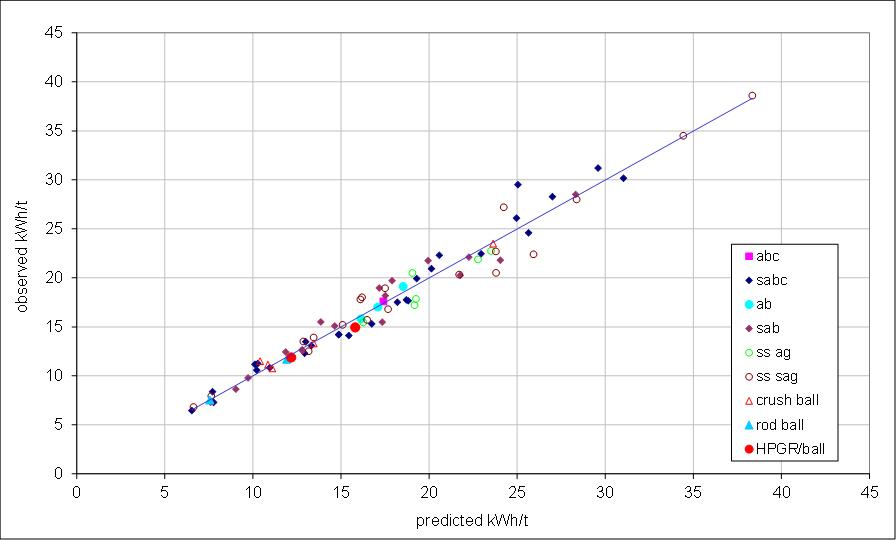
For power-based calculations the SMC Test® also provides the comminution indices Mia, Mih and Mic ,which are routinely reported when a test is carried out (see Table 1 below). In conjunction with the Bond ball mill work index they can be used to accurately predict the overall specific energy requirements of circuits containing:

- AG and SAG mills.
- Ball mills
- Rod mills
- Crushers
- High Pressure Grinding Rolls (HPGR)

For detailed information about how this can be done, click here for the document “Using the SMC Test® to Predict Comminution Circuit Performance” which provides both equations and worked examples.

Table 1 – Example of Standard Output Report from SMC Test®

Standard output report


Background

The SMC Test® is a precision test that uses either crushed rock pieces that are very closely sized (so-called crush and select method) (Figure 1) or particles that are cut to similar size from drill core using a diamond saw (Figure 2). The latter approach (so-called cut-core method) is used when limited drill core sample is available. Almost any drill core size is suitable, even core that has been quartered (slivered). The chosen particles are broken using a closely controlled range of impact energies. The high degree of control imposed on both the size of particles and the energies used to break them means that the test is largely free of the repeatability problems which plague tumbling mill rock characterisation tests. Such tests usually suffer from variations in feed size, which are not closely controlled, as well as energy input, which although is often assumed to be constant is often highly variable.

Figure1

Figure 1 – Particles Selected for SMC Testing from Crushed Rock

Figure2

Figure 2 - Particles Selected for SMC Testing from Cutting Drill Core

The question is sometimes asked as to whether there is any difference in SMC Test results between using cut core or crushed core samples. This was considered during the early development of the SMC Test and testing protocols were tailored to ensure that no differences resulted. To confirm this experiments were carried out in which large lumps of ore were cored and the remains of the lumps then crushed. Test pieces were then prepared from the drill core using the cut core method whilst the crush and select method was used on the crushed lump material. Both types of sample were then broken independently in the drop-weight tester to determine if there were differences in the results. The raw data from these tests are shown in Figure 3. No significant difference between the two data sets was found.

figure3

Figure 3 – Cut Core vs Crushed Core Test Results

SAMPLE QUANTITY

The amount of sample that is required depends on what sources are available to provide the rock samples eg, is it drill core, what size of core, is it whole, halved or quartered as well as the size fraction chosen to do the SMC Test® and whether the sample is going to be prepared but crushing or cutting. These factors are best discussed with your local metallurgical laboratory when you are at the planning stage. However, the table below is a useful guide. Also remember that the products from the SMC Test® can be re-used for Bond ball work index testing, the SMC Test® being effectively used as a feed preparation step for the Bond ball work index test. As a general rule Bond ball work index tests are recommended when SMC Tests® are carried out as this provides valuable additional information on the way that much finer particles break.

Table 1 – Guide to Sample Requirements

Table1


CALIBRATION for DETERMINATION of Mia, Mih and Mic PARAMETERS

No calibration is required to generate Mia, Mih and Mic parameters from a SMC Test as they are fixed functions of the DWi, which in turn is produced as a standard output from the SMC Test®.


CALIBRATION for DETERMINATION of A and b PARAMETERS

Where the SMC Test® is used to estimate values of A and b (used in the JK AG/SAG mill model) a so-called “calibration” may be required. The relationship between the DWi and the JK rock breakage parameters A and b makes use of the size-by-size nature of rock strength that is often apparent from the results of well controlled tests on different size fractions. This is illustrated for a range of different rock types in Figure 4, which shows how the gradients of the plots of normalised values of A*b vary with particle size. In the case of a conventional drop-weight test the A*b values for each particle size are effectively averaged and a mean value of A and b is reported. The SMC Test® uses a single size and makes use of relationships such as that shown in Figure 4 to predict the A and b of the particle size that has the same value as the mean for a full drop-weight test through the use of a so-called calibration factor. The average particle size of a full drop-weight test is approximately 30mm and where the SMC Test® is carried out on particles similar to this size the calibration factor approaches unity and hence calibration should not be required. In cases where the particle size used in the SMC Test® is not 30mm, eg where only relatively small diameter drill core is available or the drill core has already been slivered into half or quarter core, then a calibration factor has to be applied. Determination of the calibration factor can be done in three ways:


Using the SMC Testing data base: this shows that for a given particle size used in the SMC Test® the calibration factor has a very narrow distribution. Where the SMC Testing data base is used for calibration, the modal factor for that particle size is used. Figure 5 shows the distribution of calibration factors for 20.6mm particles. Although the distribution of calibration factors is narrow, there is still a possibility that the true factor is slightly different to the modal one. As a result the precision associated with the estimate of A*b suffers slightly. This can be represented mathematically and it is found that the precision is a function of the particle size used, as Figure 6 shows. The relationship indicates that as the particle size used in the SMC Test® approaches the average used in the drop-weight test the precision of the test reaches a minimum. This minimum is similar to that reported for the precision of a full drop-weight test. Hence where the particle size used in the SMC Test® is approximately 30mm the results obtained by calibration using the SMC Testing data base are not significantly different to those that are obtained from a full drop-weight test, ie under such circumstances calibration using a full drop-weight test (see below) should not normally be required.


Using the results from a full drop-weight test on an ore sample representative of the type used in the SMC Test®: In this case the standard drop-weight test raw data are analysed on a size-by-size basis. As 5 different size fractions are used in a full drop-weight test, this generates 5 different values for A*b which should fall on a smooth curve such as those illustrated in Figure 5. This curve is used to estimate the A*b value of the average size used in the drop-weight test and the A*b value of the size used in the SMC Test®. The results are used to determine the calibration factor appropriate for other SMC Tests® on similar ore types. Due to the way the drop-weight test is carried out and the fact that only three data points are available per size fraction to determine the size-by-size A*b relationship, scatter is often apparent in the result, making the determination of the true size-by-size relationship difficult. As a result the preferred technique is to use the third method.


SMC Tests® are carried out on three different size fractions from a representative ore sample. The recommended size fractions are: -31.5+26.5mm, -22.4+19.0mm, -16.0+13.2mm. As the SMC Test® is so closely controlled, plus the fact that five data points per size fraction are generated, the true A*b variation with particle size is much easier to determine than in a full drop-weight test. This relationship is then used to determine the calibration factor appropriate for other SMC Tests® on similar ore types. Because it gives such a good estimate of the true size-by-size A*b relationship it can be used to predict all of the individual results from a full drop-weight test with an accuracy and precision at least equal to if not superior to a full drop-weight test.


Figure4

Figure 4 – Relationships Between Particle Size and the Product of A and b

Figure5

Figure 5 – Calibration Factor Distribution for 20.6mm Particles


Figure6

Figure 6 – Precision Associated with the Use of Different Particle Sizes in SMC Tests® - calibrated using the SMC Testing database