



The content on this page was automatically generated from the PDF publication document and may contain errors or inaccuracies. Please refer to the original PDF for the most accurate information.
INCREASED PROFITS THROUGH MINE-AND-MILL INTEGRATION
By
S. Morrell and P.D. Munro
ABSTRACT
The Mine to Mill concept, as it has become known by, is a philosophy which is being increasingly embraced by mining companies committed to increasing their profitability through better integration and global optimization of their mining and processing operations. As the performance of autogenous (AG) and semi-autogenous (SAG) mills, which are the principal primary grinding devices currently in use, are particularly sensitive to feed size distribution, most efforts to date have centred on modifying and controlling the run-of-mine (rom) size distribution to maximize grinding mill throughput.
The complexity of the interaction between rom size distribution, primary crusher product and AG/SAG mill performance precludes the trial-and-error approach as an effective means of determining the optimum blast-induced fragmentation size distribution. To overcome this limitation the Julius Kruttschnitt Mineral Research Centre (JKMRC) has developed modelling and simulation techniques that are able to accurately reproduce both the fragmentation process during blasting and the subsequent performance of the comminution circuit. These models are tailored to suit local ore types, rock structure and comminution circuit design and calibrated using high quality field data.
MIM Holdings Limited (MIM) have been particularly active in the Mine to Mill area and have instituted optimization programs at three of their associated base metal operations viz. Alumbrera, Ernest Henry and Mount Isa Mines Limited. This paper describes these programs with particular reference to the data acquisition and modelling phases, the predictions of potential productivity gains and the extent of the realisation of these gains to date.
INTRODUCTION
The Mine to Mill concept, as it has become known by, is a philosophy which is being increasingly embraced by mining companies committed to increasing their profitability through better integration and global optimisation of their mining and processing operations. The potential improvements that can be made are considerable, at least two major mining companies recently reporting in keynote addresses (Pease 1998; Johnston 1998) that profitability had increased by US$35 000 000/y through the adoption of Mineto-Mill principles.
Both mining and processing operations involve a variety of steps, each with their own attributes and own requirements for optimum efficiency. However, in some cases the conditions required to optimise one of these steps are counterproductive to optimisation of another. As a result a strategy of locally optimising each step may not give the best overall performance. This warrants an approach in which conditions for each step are varied so as to achieve global optimisation. The number of steps, their complexity and interactions in most mining/processing operations make trial-and-error attempts at achieving this difficult and costly to carry out. However, modelling and simulation offer a far more cost-effective and rapid route to the achievement of a successful outcome. This outcome could be increased revenue from a higher iron ore lump:fines ratio, increased grinding throughput rates or a new dump/heap leach size distribution which enhances the recovery of valuables.
Over the last 3 years the JKMRC has concentrated effort on the size reduction aspect of the Mine-to-Mill concept and in so doing developed improved models describing the fragmentation for blasting. These now provide a reasonably realistic response to blast design and rock character changes, particularly in the -100mm size fraction which is of most importance in determining comminution machine response. Coupled with the latest models of the principal comminution and classification machines, this has enabled blasting/comminution optimisation studies to be carried out via simulation which have identified potential strategies to significantly improve profitability. MIM has been quick to capitalise on these opportunities by instigating studies at three of their associated base metal properties viz. Alumbrera, Ernest Henry and the Copper Concentrator at Mount Isa Mines Limited. The attraction of Mine-to-Mill is the possibility of a significant increase in grinding throughput for negligible capital cost.
PROCEDURE
Initially the most important steps in the mining/processing route have to be identified. Data are then collected on their performance, after which they are modelled. The blasting and comminution stages are then simulated to identify the most profitable combination of conditions. Implementation and evaluation stages then follow. Several iterations may be necessary to reach the ideal condition. On-line measurement and control systems are then needed to maintain the optimum conditions. The five stages required are summarised below.
- 1) characterisation of appropriate in-situ ore properties,
- 2) modelling and simulation of the performance of each step,
- 3) simulation of the conditions to achieve overall optimum performance,
- 4) implementation of a strategy to achieve optimum performance and,
- 5) the on-line tracking and measurement of the ore and its relevant properties throughout the various processes.
All five stages have been completed at Alumbera while Ernest Henry has reached stage 4. The Copper Concentrator program at Mount Isa has only been recently started and is currently at stage 2.
DESCRIPTION OF OPERATIONS
Geology
The Alumbrera porphyry copper-gold deposit in Argentina has a bowl shape, slightly longer in the northeast-southwest direction (1900 m x 1200 m). The depression, surrounded by ridges, is formed mostly by andesitic breccia of the Farallón Negro volcano. The present base of the bowl is at an altitude of about 2650 m and covers an area of 2.5 km2.
The Alumbrera porphyries derive from a series of intrusions into the roots of Farallón Negro volcano. The intrusions and the associated hydrothermal fluids resulted in alteration and mineralisation of the porphyries and the volcanic host rocks. Erosion has exposed the upper part of the volcano and its porphyry system to its present level.
The ore grades correlate with lithology, with the highest copper-gold grades associated with the intense potassic alteration of the earliest porphyritic intrusions and in adjacent biotised or potassium feldspar altered andesites. Younger porphyries are less mineralised or barren. Copper and gold are positively correlated with a significant proportion of free gold in grains of 10 to 50 microns in size. The underlying supergene enrichment is erratic in its development, occurring at depths to 150 m in some places and being barely recognisable at other locations.
Grinding throughput at Alumbrera can be highly correlated to rock type with the rock types P1, P2, P3 and FA having nominal treatment rates on a ceteris paribus basis ranging from 72 755 t/d for the FA andesite to 99 685 t/d for the P2 porphyry.
The main rock type at the Ernest Henry copper-gold deposit in the north west of Queensland is a variably foliated, brecciated and altered felsic volcanic rock. These rocks are dominated by feldspar with minor quartz and ferro-magnesian minerals and are characterised by fine grained magnetite-biotite alteration.
The host for mineralisation is almost exclusively brecciated felsic volcanic rock. The deposit exhibits gross zoning from altered unbrecciated felsic volcanic rocks on the perimeter of the deposit, progressing inwards to clast and matrix supported breccias as the proportion of matrix increases.
Mineralisation can be divided into two main zones; the supergene and the primary. The supergene zone comprises material which has been modified by weathering processes and therefore lies above the Base of Partial Oxidation ('BOPO'). The primary zone lies below the BOPO and shows no effect of weathering. Supergene ore makes up 15% of the ore body and primary ore makes up the remaining 85%.
The primary ore mineralogy is quite simple. The ore assemblage is dominated by chalcopyrite within a magnetite-carbonate gangue, there are no other oxides or sulphides of economic importance. The mean magnetite content of the primary ore is 20-25%. Magnetite is important in that the copper grade increases with increased matrix, percentage of magnetite and consequently specific gravity.
Pyrite is abundant but decreases with increasing chalcopyrite in the higher grade zones. Gold shows a strong positive correlation with the chalcopyrite, The supergene ore zone is much more mineralogically complex. The complex overlying of sulphides in the supergene zone is the result of several oxidation/reduction events. The predominant copper species in the supergene profile are chalcocite, secondary chalcopyrite, bornite and native copper. "Chalcocite" is used here to denote a group of copper sulphide minerals which includes djurleite and digenite. Secondary chalcopyrite is the product of the reduction of chalcocite. Native copper occurs in two distinct forms; a very fine grained disseminated distribution, and a coarse grained variation.
The mineral distribution is complex and there is little correlation between mineral distributions in adjacent drill holes at 40m spacing. There is no apparent relationship between gold and copper in the supergene zone. Gold is usually extremely fine grained and has been noted in interstitial gangue sites and in the sulphides.
The complexity of the supergene ore zone in terms of gangue and copper mineralisation and the variability in the mineral species distribution makes it difficult to predict both the metallurgical behaviour of the ore and the grinding throughput. Treatment of both supergene and primary ore with the former predominating since commissioning in late 1997 has made it difficult to correlate plant performance with ore and rock type.
The copper sulphide orebodies at Mount Isa are restricted to zones of recrystallized and deformed Urquhart Shale locally known as "silica-dolomite". Chalcopyrite is the only economic copper mineral with the other main sulphide being pyrite which is present in both the coarser euhedral form and very fine-grained carbonaceous variety.
The ore is generally very hard and competent. The silica content has increased from around 42% in the early 1970's to nearly 70% in the late 1990's as mining has moved from the 500 and 650 orebodies to the 1100 orebody with future production coming from the deeper 3000/3500 orebodies. Variations in grinding throughput are best correlated to changes in the rom ore size distribution which is exacerbated by severe segregation in the large crude ore bin ahead of the grinding mills.
Blasting
Typical blast designs for Alumbrera and Ernest Henry are shown in Table 1.
| E/Henry | Alumbrera | |
|---|---|---|
| Drill diameter (mm) | 270 | 311 |
| Bench height (m) | 16 | 16 |
| Burden (m) | 6.9 | 8.5 |
| Spacing (m) | 8 | 11 |
| Hole depth (m) | 18 | 18.5 |
| Explosive weight (Kg) | 930 | 1003 |
| Stemming length(m) | 5 | 8 |
| Subdrill | 2 | 2.5 |
|---|---|---|
| Explosive | Emulsion | Mex 150 |
| Explosive density g/cc | 1.25 | 1.32 |
| VOD m/s | 4500 | 5000 |
| Powder factor kg/m3 | 1.05 | 0.64 |
Comminution
Alumbrera, Ernest Henry and the Copper Concentrator at Mount Isa all have SAG/AG mills followed by ball mills. Table 2 below summarizes the principal equipment sizes. At Mount Isa one of the primary mills runs in AG mode whilst the other runs in SAG mode. In addition the primary mills are partly in closed circuit with hydrocyclones ie some of the primary hydrocyclone underflow is recycled to the primary mill whilst the remainder joins the overflow going to the secondary mills.
| Primary crusher Primary mill |
no.
type no. |
Alumbrera
1 gyratory 2 |
E.Henry
1 gyratory 1 |
Mt. Isa Cu.
1 jaw 2 |
|---|---|---|---|---|
| Secondary mill |
type
diameter(m) length(m) no. |
sag
11 5.5 4 |
sag
10.4 5.2 2 |
ag/sag
9.8 4.4 2 |
|
Hydrocycl
ones |
type
diameter(m) length(m) diameter(m) |
ball;o/flow
6 9 0.66 |
ball;o/flow |
ball;o/flow
5 6 0.5 |
MODELLING
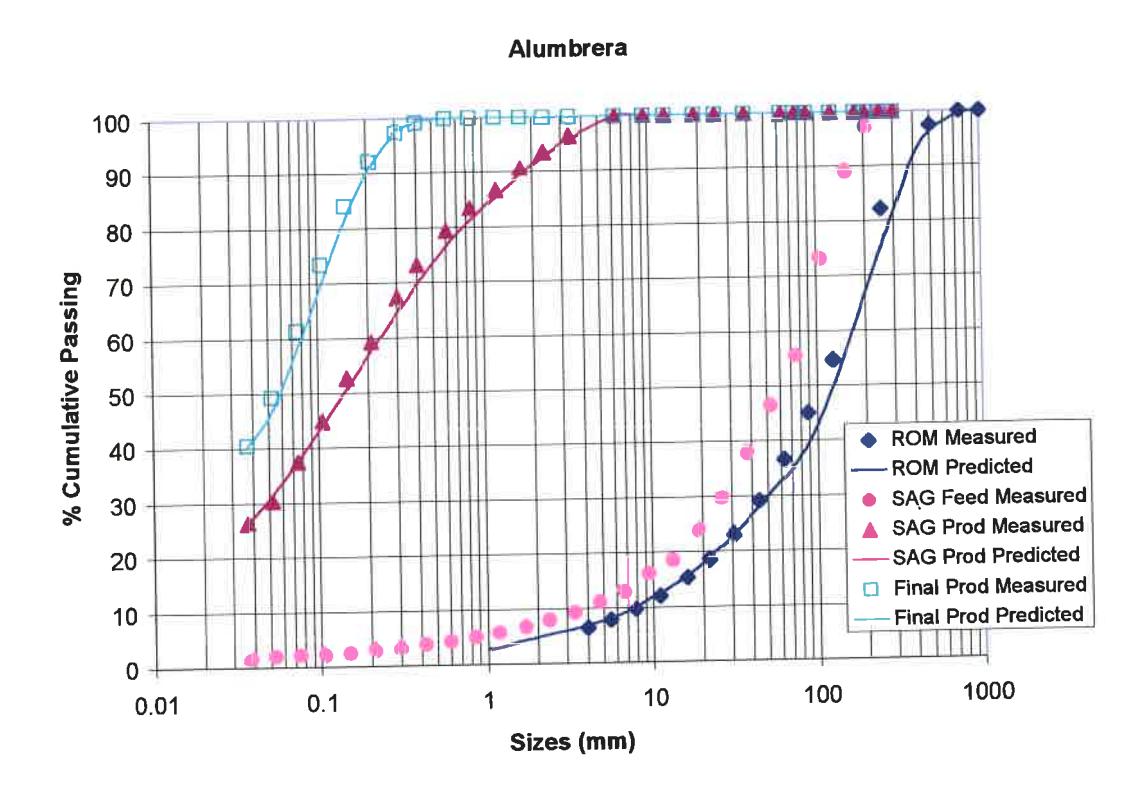
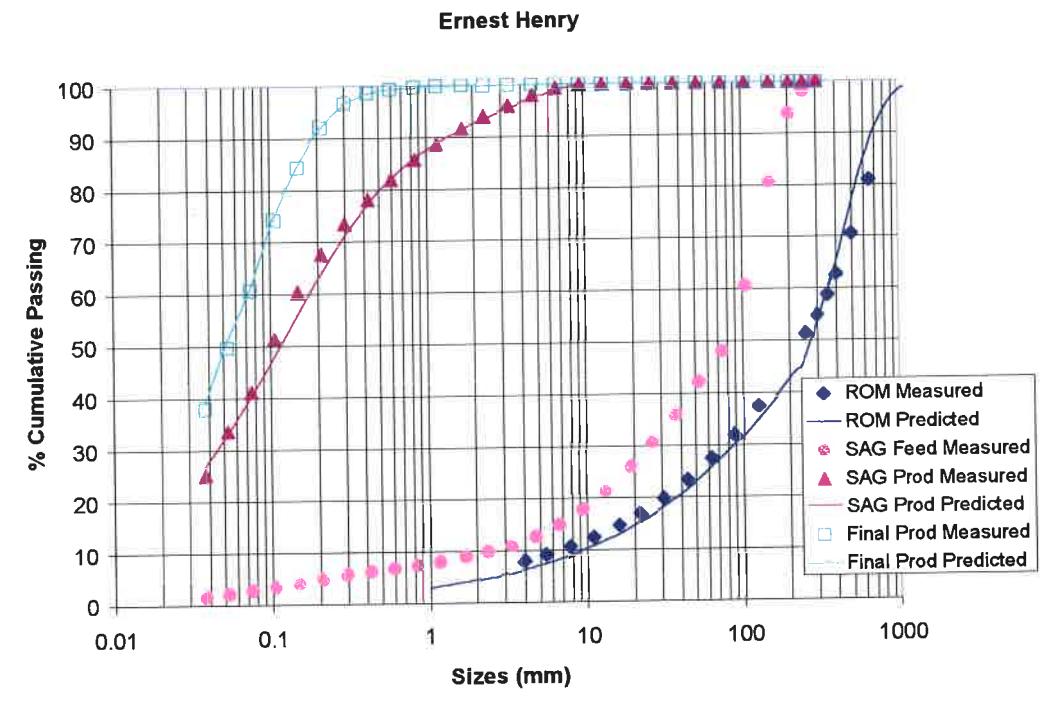
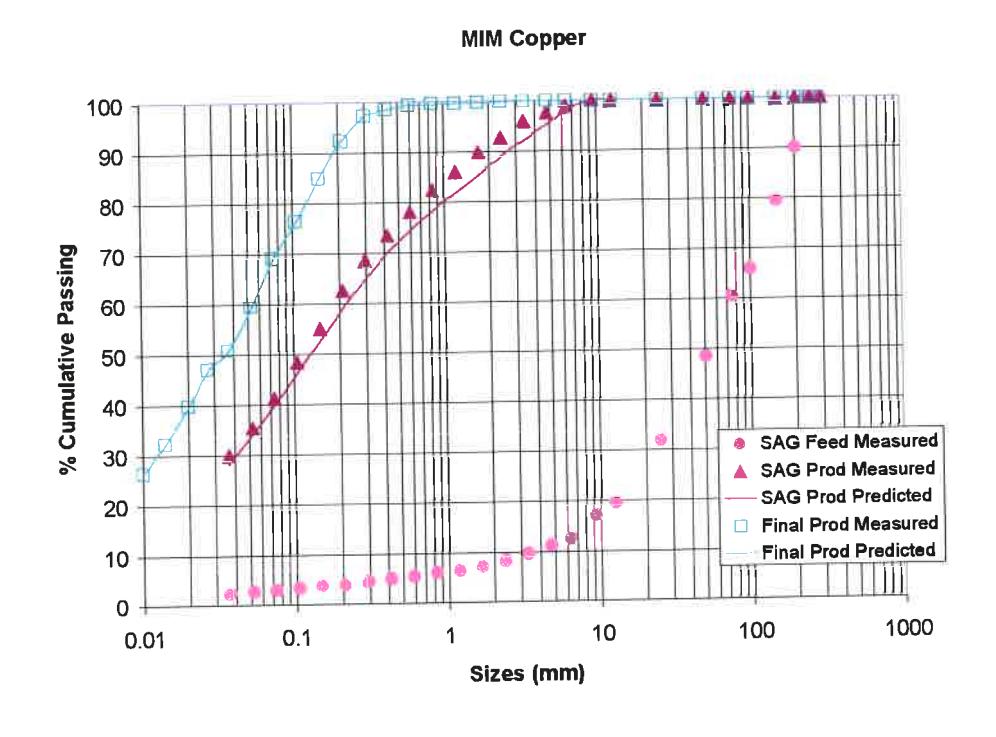
To date comminution models have been constructed for Alumbrera, Ernest Henry and Mount Isa Mines circuits plus blast models for both Alumbrera and Ernest Henry. These models were calibrated using data from blast audits, rom ore size distribution measurements and surveys of the comminution circuits. The ability of the models to reproduce observed data are illustrated in Figures 1-3 which show the observed and predicted distributions from the rom to the final hyrocyclone overflow at each site.
DETERMINING OPTIMUM CONDITIONS
General Strategy
The three most significant deficiencies in sub-optimal blast designs, as measured by poor comminution circuit performance are:
- Variability in rom size distribution
- Too-large a top size fed to the primary crusher
- Insufficient fines (-10mm) in the rom
In addition there are issues with regard to top size and the amount of -75+25mm material in the primary crusher product. AG and SAG mills respond in a somewhat different manner to their feed size distribution so it is dangerous to make generalities in terms of what is the ideal mill feed size. However the general trend is that AG and SAG mills work better if the -75+25mm fraction is minimised and top size (F80 is often a good indicator) is not excessive. The latter trend is more pronounced with SAG mills and typically the higher the ball charge the lower should be the top size.
To improve all of the above, the strategy adopted is to ensure that blast design is tailored to rock properties such as competence and structure and the blast pattern, initiation sequence and timing are such that back-break is minimised. This reduces the variability in the rom ore size distribution and often goes a long way to reduce top size problems in primary crusher feed. To increase the amount of fines in the blast the first step is to increase the explosive energy utilised in breaking the in-situ rock. This may be achievable by simply improving stemming (using crushed aggregate rather than drill chips) and/or increasing powder factor. Reducing drill hole size may also be beneficial in this respect. Once these changes are made the primary crusher closed side setting (css) can often be significantly reduced without detriment to productivity and this typically results in further gains for the mill.
An initial stumbling block when attempting to implement these changes is the immediate impact on mining costs, the increase to which is often vigorously resisted. This reaction, although understandable in the context of a local key performance indicator (KPI) which penalises higher mining costs, is not defensible in terms of the potential increase in company profitability when the impact on the concentrator is taken into account. The indicative figures for an open pit operation which are given in Table 3 support this argument. It is quite clear that the grinding cost per tonne dwarfs that of blasting by an order of magnitude. Thus in this case if it were possible through improved blasting to reduce the grinding cost per tonne by say 8-9% (by increasing grinding throughput), blasting costs could be doubled and still have a positive effect on overall profitability.
| Cost ($/tonne) | Energy (kWh/t) | |
|---|---|---|
| 0.15 | 0.2 | |
| 0.25 | 2.0 | |
| 1.75 | 20.0 | |
|
0.15
0.25 |
||
Indications of Improvements
The actions most likely to result in significant gains can be identified by applying the blasting and comminution models to explore the interaction between blast design and mill throughput,. This has been done at both Alumbrera and Ernsest Henry. At Mount Isa Mines blast modelling has yet to be completed.
Ernest Henry
The approach taken at Ernest Henry was to simulate a progressive reduction in burden and spacing and to increase powder factor. At the same time the primary crusher gap was reduced from its normal setting of 130mm to 115mm. The resultant SAG mill feed size was reduced across the entire distribution. The simulated effect on throughput was as shown in Figure 4.
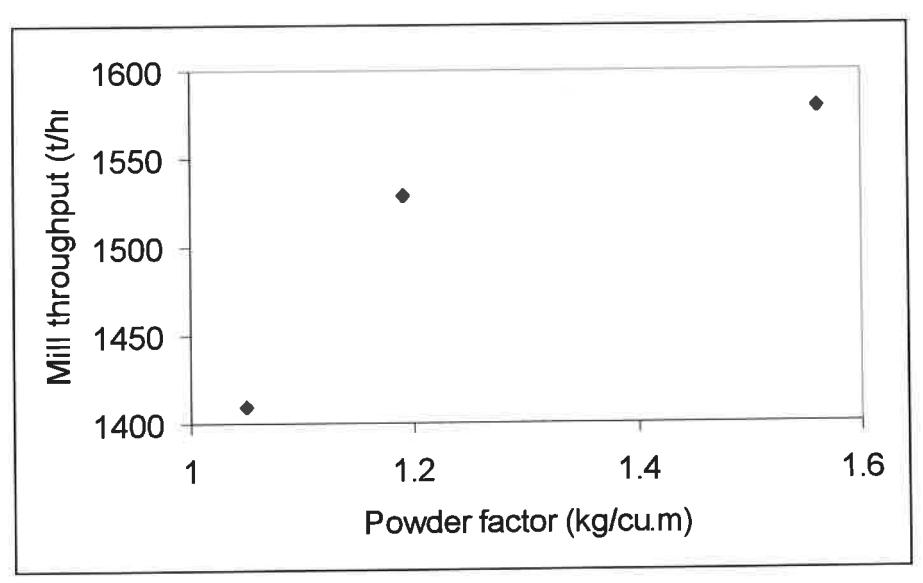
The plot in Figure 4 shows that a significant gain in throughput (8.5%) can be made with an increase in powder factor of 13%. On a cost basis the increased powder factor is equivalent to 0.07 $/tonne. Increasing powder factor further is predicted to increase mill throughput but at a lesser rate. This is due to the fact that there is a limit to which the primary crusher gap can be closed. Thus, as the rom becomes finer a situation may be reached where the primary crusher is unable to do any additional useful work on the rom and hence cannot fully capitalise on the finer blast.
Alumbrera
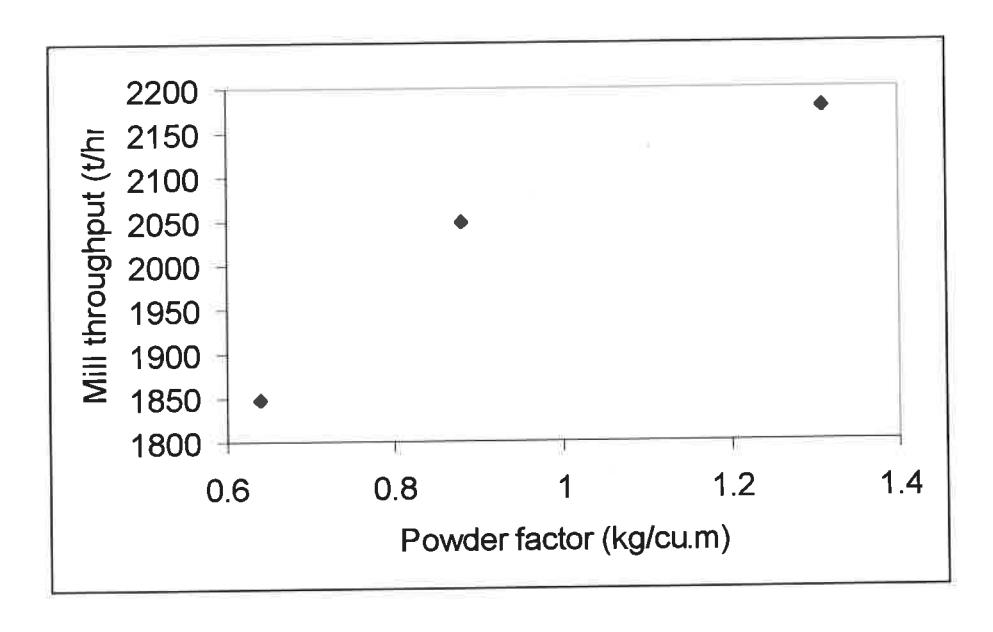
The approach taken in the simulations for Alumbrera were identical to those for Ernest Henry. The results are shown in Figure 5 These indicate once again that the powder factor/mill throughput relationship is not linear but eventually flattens out when the powder factor reaches a limiting level. The highest proportional gains were indicated to result from an increase in powder factor from the "traditional" level of 0.64 kg/cu.m to 0.87 kg/cu.m - an increase of 35%. Throughput of the intermediate hardness ore was expected to increase by 11%.
IMPLEMENTATION
To date implementation of the simulated changes have only been tested at Alumbrera. Ernest Henry plans implementation trials in early 2000. At Alumbrera the trial was conducted using a 2.7 million tonne parcel of ore. Powder factor was increased by 35%. In addition a new concave and mantle was installed in the primary crusher to enable its css to be reduced from its usual minimum of 155-160mm to 125mm. During the trial the finer fragmentation and reduced top-size enabled crusher throughput to be maintained at required levels despite operating at the smaller css. Crusher availability actually increased during the trial period due to the elimination of bridging with oversize rocks. In terms of milling the mean throughput increased by 13%, this increase being in line with the simulation predictions.
The higher powder factor superficially increased mining costs of US$0.05-0.07 per tonne but this would be far outweighed by the reduced costs in the concentrator on a unit tonne of ore basis. However the most important economic benefit is the potential to increase project revenue per hour of concentrator operating time as this is the rate-limiting step in the operation.
CONCLUSIONS
In most mines grinding capacity is available in large discrete units with a high capital cost e.g. a 10MW SAG mill is likely to cost $30 000 000. The great benefit of the Mineto-Mill approach is that it can increase grinding throughput without any capital outlay. Some operations may require capital expenditure for additional drilling equipment and instruments to monitor parameters such as particle size distributions of coarse ore streams but the total amount would be minor compared with installing additional grinding capacity..
What appears to be increased operating costs for drilling and blasting is easily seen to translate into lower operating costs for the whole operation after taking into account the effect on downstream processing. Indeed there may well be only a small increase in total mining cost after considering the beneficial effects of finer fragmentation from blasting such as increased shovel and loader digging rates, higher truck fill factors, reduced secondary blasting, less equipment damage from oversized rocks etc.
The Mine-to-Mill approach offers the opportunity to substantially improve the profitability of an operation that uses a grinding process by increasing the revenue per operating hour. This can be done with minimal capital expenditure and no increase in operating cost considering the mining and processing steps as a whole.
REFERENCES
Pease, J.D., 1998, Lessons From Manufacturing – Integration Of Mining And Milling For A Complex Orebody, Keynote Address at Mine To Mill Conference , Brisbane, 11-14 October 1998
Johnston, .D., 1998, The Human Side Of Co-ordinating Mine To Mill Activities, Keynote Address at Mine To Mill Conference , Brisbane ,11-14 October 1998