



The content on this page was automatically generated from the PDF publication document and may contain errors or inaccuracies. Please refer to the original PDF for the most accurate information.
ORE COMPETENCE AND THE ENERGY EFFICIENCY OF DIFFERENT COMMINUTION CIRCUITS
S.Morrell
INTRODUCTION
As little as 10 years ago a "conventional" comminution circuit in many metallurgists mind would have conjured up pictures of crushing-ball mill or rod mill-ball mill circuits. Today it is not common to find such circuits in operation, let alone being built. Autogenous (AG) and semi-autogenous (SAG) mills now dominate circuit design in gold and base metals applications and can rightfully lay claim to being conventional, leaving technologies such as high pressure grinding roles the title of "new". Regardless of how one categorises these technologies, today a much wider spectrum of proven equipment is available to the circuit designer than, say, 25-30 years ago. Although such choice may be seen as an improvement it provides a particular challenge in terms of assessing which circuit is the most appropriate for a given ore type and how in the first place the ore type should be described in terms of its breakage characteristics. In this paper data from a range of circuits and ore types is reviewed to determine whether there is any evidence to suggest that from an energy efficiency viewpoint certain circuits are better at treating particular ore types than others. In the course of this review the methods by which circuit energy efficiency is normally assessed are evaluated and shown to be fundamentally flawed. This conclusion brings into question how differences between the energy efficiency of circuits have been portrayed in the past. The paper concludes with a description of an alternative way to compare circuit energy efficiency and ore competence that appear from operating data to be more soundly based.
CIRCUIT SELECTION
For AG/SAG mill circuit selection piloting is still regarded as being the best option for estimating what the performance of the full-scale circuit will be. Tests are normally conducted under a range of
conditions, the choice of circuit then being made on the basis of a number of criteria, which normally include factors such as minimum specific energy and/or maximum power utilisation efficiency. The specific energy is easy to determine as it is unambiguously defined as the power draw divided by the throughput. However, in the case of the power utilisation efficiency the approach is not so well defined. A common choice is to use the Bond equation to calculate the Bond operating work indices for each of the tests. This equation is written as:
where
W = Specific energy
OWi = Operating work index
P = 80% passing size for the product
F = 80% passing size for the feed
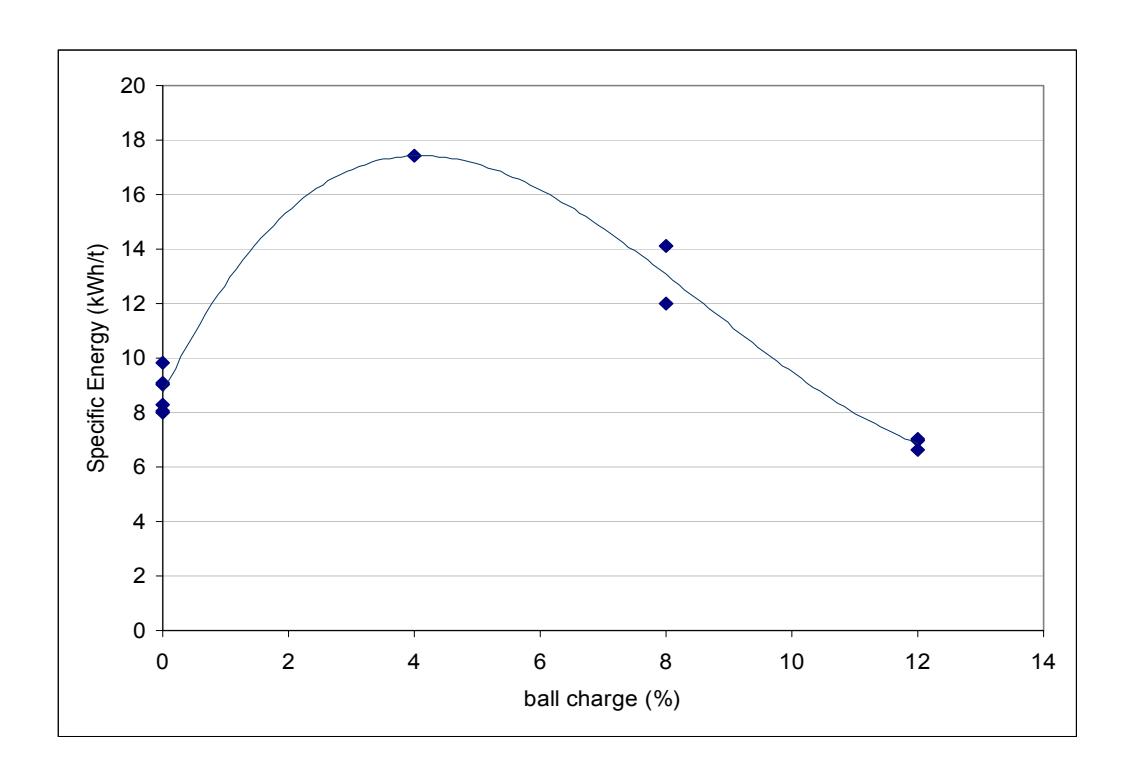
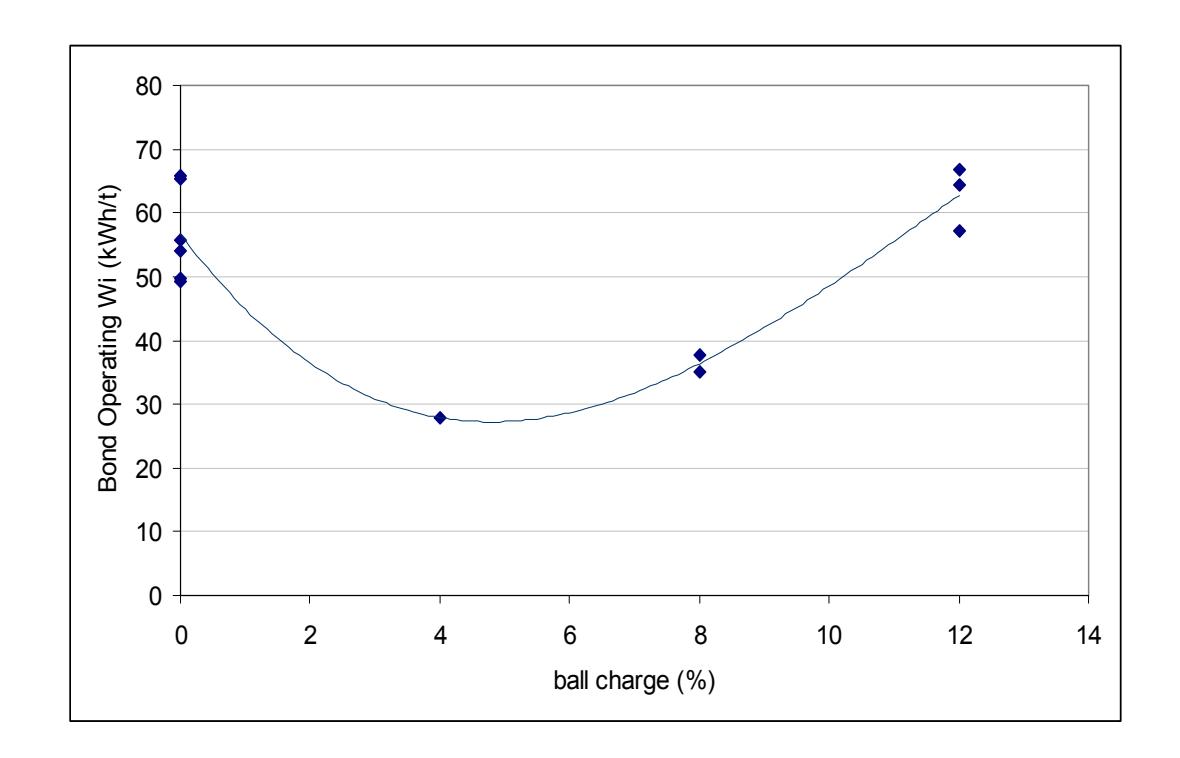
By way of example data from a pilot programme are given in Figure 1 and show a systematic trend in the specific energy as ball charge is varied. It is pointed out that the AG mill runs were conducted with a pebble crusher in circuit whilst the SAG mill runs were not. The data indicate that the worst condition (highest specific energy) is when about 4% of steel balls are used. When the Bond operating work indices are calculated a very different picture is obtained as shown in Figure 2. From these data the 4% case is indicated to give the best power utilisation efficiency (lowest OWi).
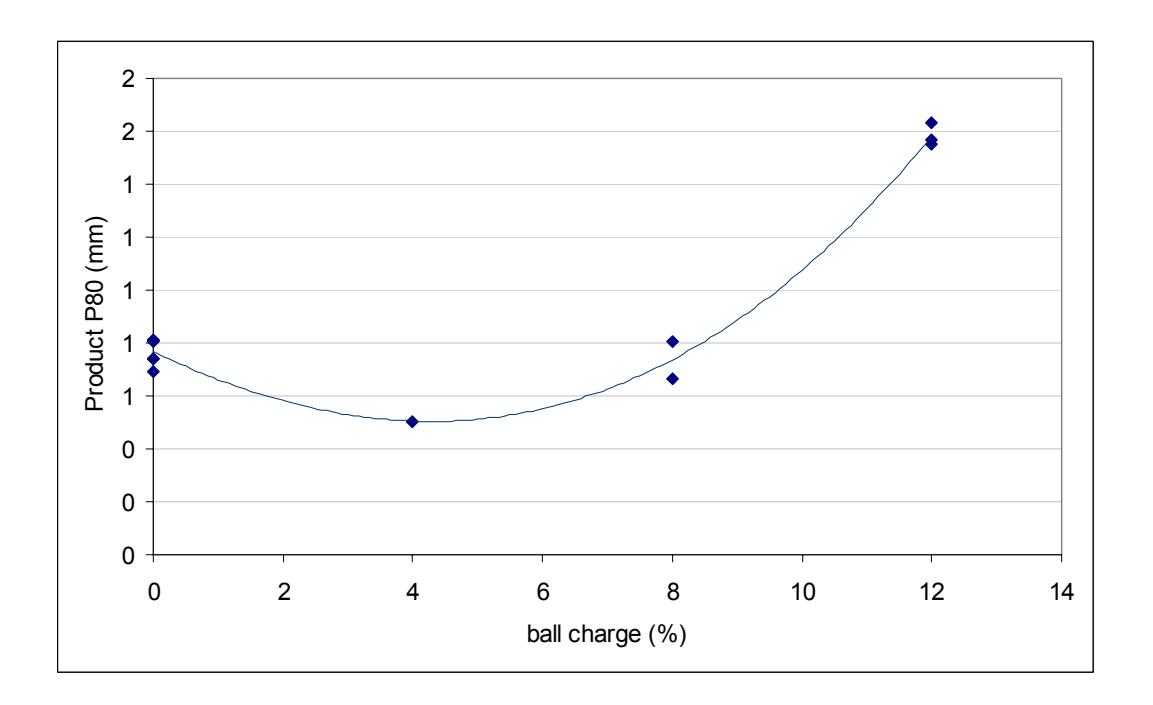
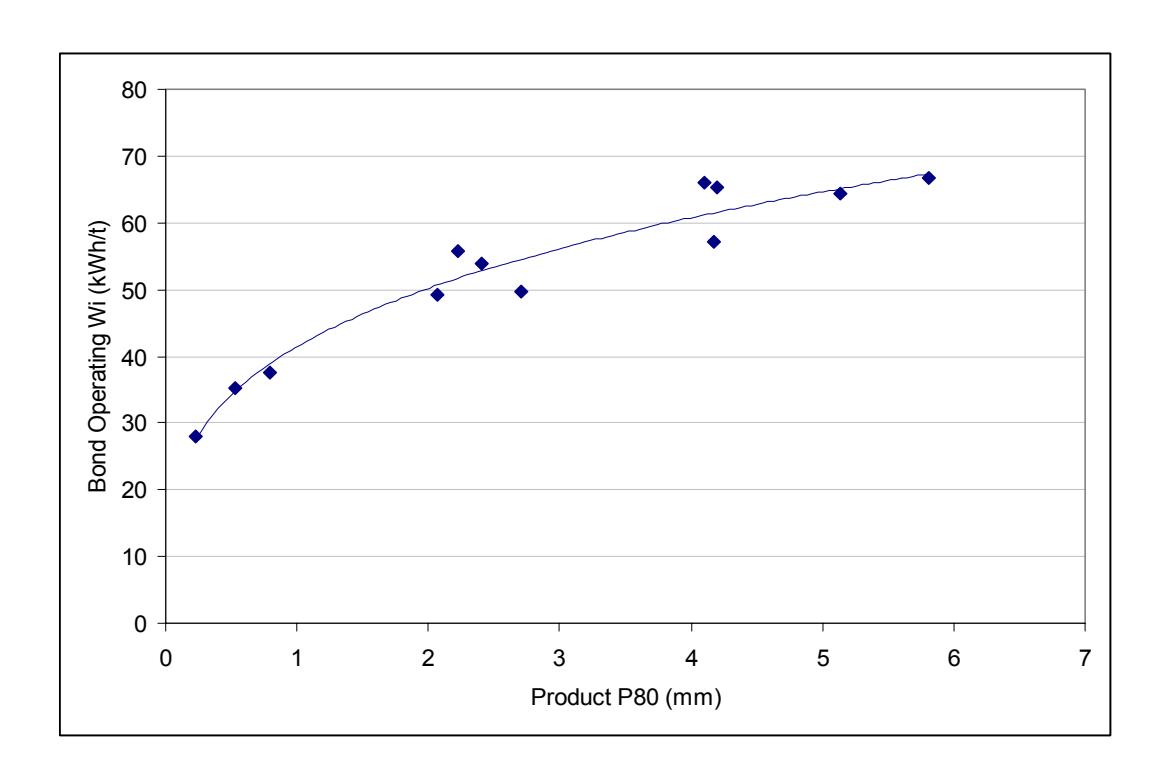
Closer analysis of the data shows that there is also a similar relationship between the ball charge and the P80 (Figure 3), indicating that the underlying relationship is in fact one that links operating work index to P80. This is confirmed in Figure 4 where a strong correlation between the Bond operating work index and the product P80 is seen. This trend, which is found in many data sets, shows a decreasing work index as the grind becomes finer and is counter intuitive. The expected result would be one in which either the operating work index remained constant (indicating constant energy efficiency and constant material properties) or it increased as product size decreased (ie the rock became harder as the product size became smaller and/or the mill became less efficient at producing a finer grind. This result points to a potential error in the Bond equation and puts into question the conclusion regarding maximum power efficiency with 4% balls.
VALIDITY OF THE BOND OPERATING WORK INDEX FOR EVALUATING AG/SAG MILL EFFICIENCY
Researchers such as Hukki have challenged the validity of Bond's equation, at least outside the range of feed and product sizes treated in ball mills. Recently an alternative equation to Bond's has been proposed (Morrell, 2003). This has the form:
$$ W = M_i K \left( x_2^{f(x_2)} - x_1^{f(x_1)} \right) $$ (2)
where
W = Specific energy (kWh/tonne)
K = Constant chosen to balance the units of the equation
Mi = Index related to the breakage property of an ore (kWh/t)
x2 = 80% passing size for the product
x1 = 80% passing size for the feed
where
a,b = constants
x = 80% passing size
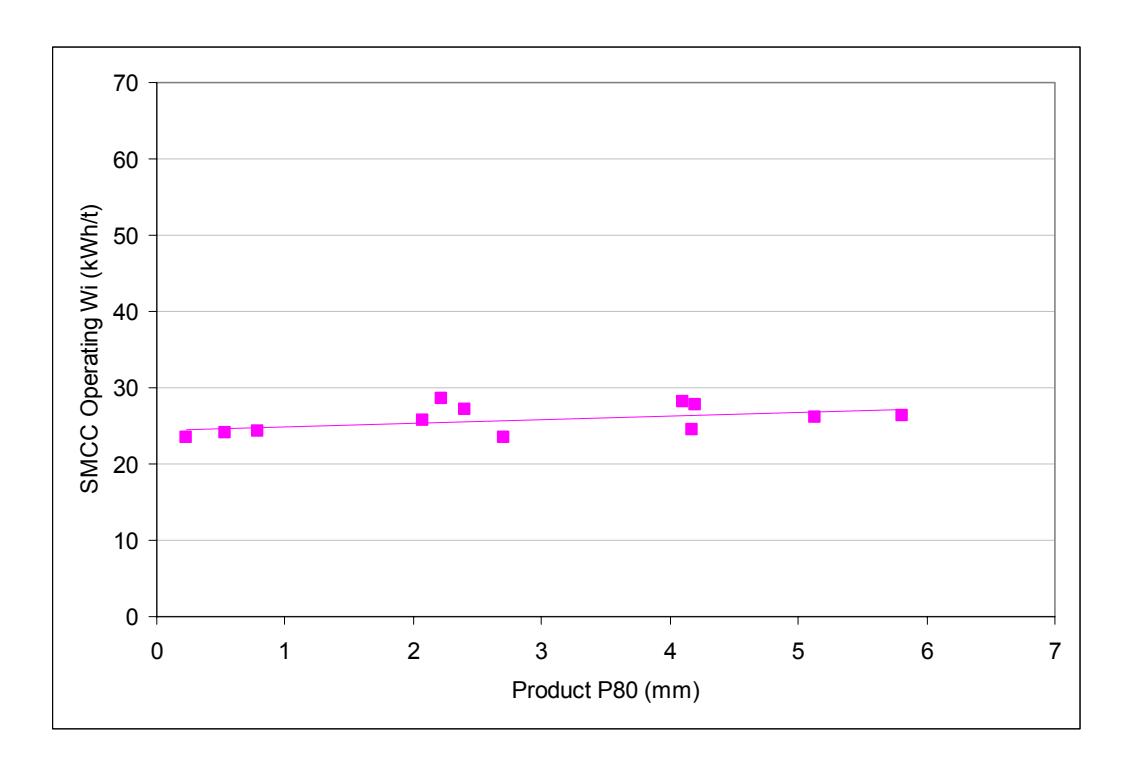
The parameters a and b have been determined from analysing a wide range of size reduction data from industrial grinding mills. Equation 2 can be used providing Mi is known. Alternatively for analysing circuit performance the equation can be rearranged such that an operating value for Mi can be calculated using plant data. This is the equivalent of the Bond operating work index. When this is done using the data from Figure 4 the results given in Figure 5 are obtained and show that the operating work index is in fact largely constant with resect to product size and hence there is no indicated difference in power utilisation efficiency between the different operating conditions.
EFFICIENCY OF AG/SAG AND BALL MILL CIRCUITS
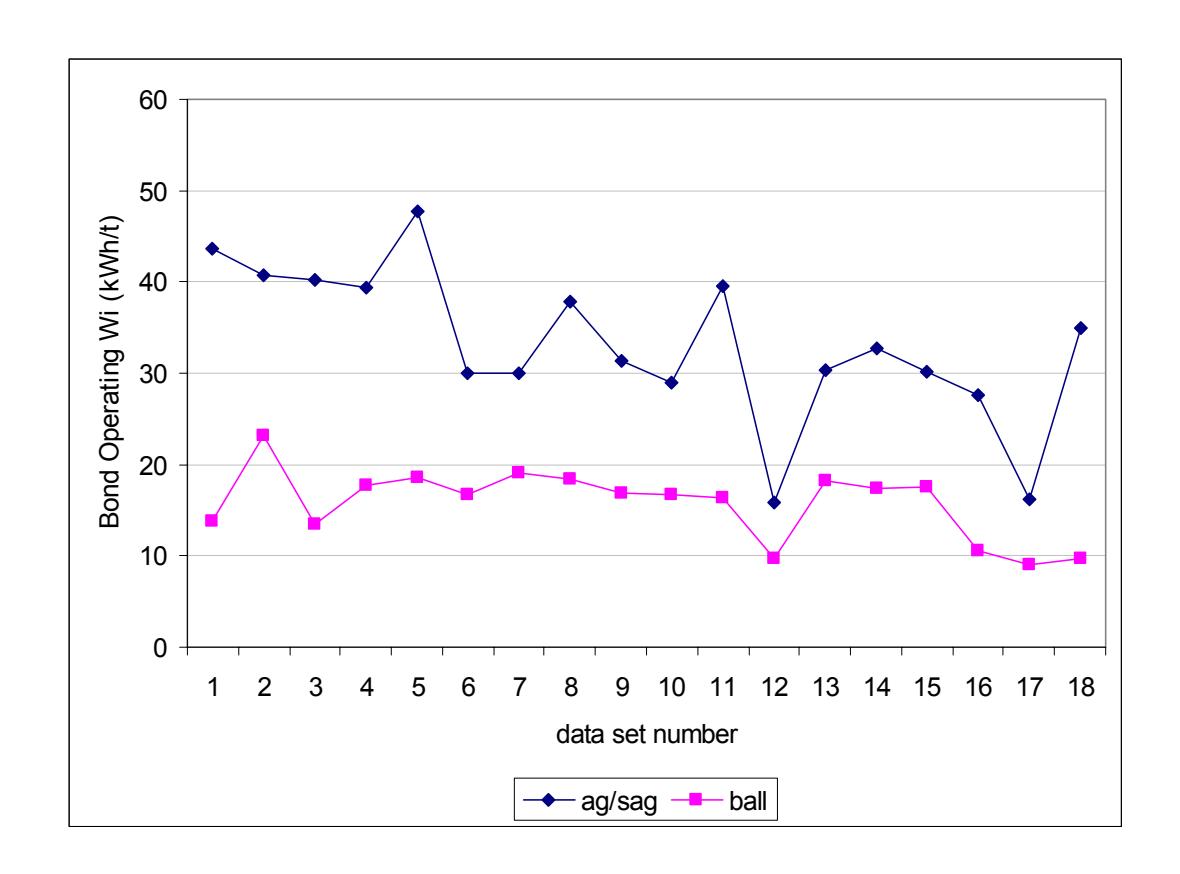
Given that the use of equation 2 indicates that there was little or no difference between the power utilisation efficiencies of the different modes of AG/SAG mill operation, the question arises as to whether the equation indicates differences in efficiency between AG/SAG and ball milling in general. Data from 18 different operations were analysed to answer this question. The data comprised throughput and power draws as well as feed, transfer and ball mill cyclone overflow sizings from each circuit. Initially Bond operating work indices were calculated for each circuit. These are plotted for each circuit and shown in Figure 6. The ball mill values largely followed the Bond laboratory work index results, which were also obtained for each ore type. The AG/SAG operating work indices show their usual elevated levels compared to those from the ball mill circuit. This has often resulted in conclusions concerning lower energy efficiencies of AG/SAG mill circuits compared to ball mills. The correlation between the AG/SAG and ball mill circuit data is also very poor.
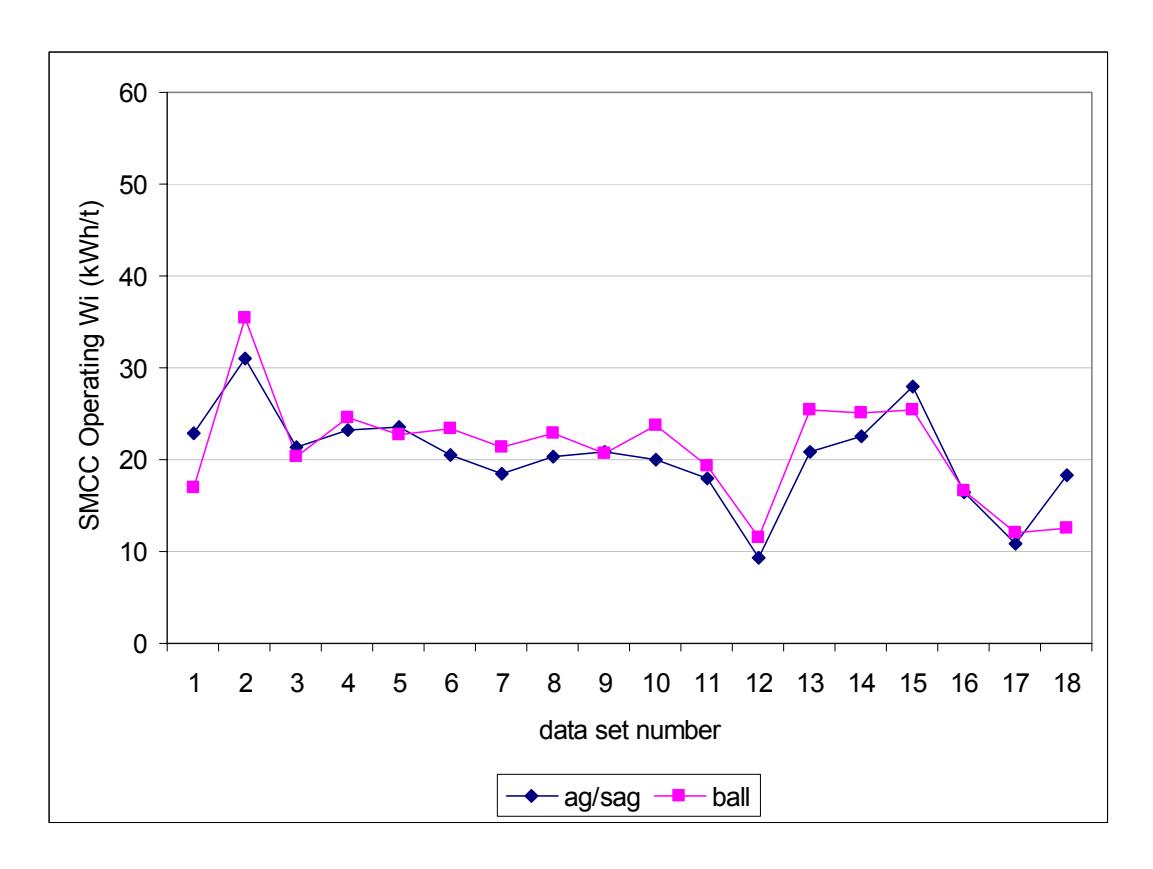
Use of the SMCC equation shows a very different picture, the results being illustrated in Figure 7. This shows that on average the operating work indices of AG/SAG and ball mill circuits are very similar and hence energy utilisation efficiencies are similar. Also the AG/SAG and ball mill circuit operating work indices are highly correlated. This shows a significant reduction in the scatter of the Bond data and indicates the benefits of an equation which more appropriately describes the relationship between energy and size.
The conclusion that AG/SAG circuit have, on average, a similar power utilisation efficiency to ball mill circuits, may run counter to much "conventional wisdom". However, controlled experiments in which very different crushing and grinding circuits have been run using identical ores have shown little difference in the energy required to reach a target grind from a given feed size (Larsen et al, 2001, Morrell et al, 1991). The analyses provided in this paper support these results and lead to the assertion that in many cases, regardless of the processing route, the energy required to grind an ore from a specific feed size to a specific product size will be similar, at least to within +/- 5%. It can be concluded from this argument that, at least from an energy utilisation efficiency viewpoint all circuits work equally well regardless of ore type. Of course, that is not to say that from a capital cost, operating cost and operability standpoint all circuits are the same – far from it. Ultimately circuit choice should be made on financial grounds. However, differences in overall power efficiency should not necessarily play a prominent role in decision making as, when analysed correctly, data show that little differences exist between circuit power efficiencies. These arguments relate to conventional crushing and tumbling mill circuits. The use of High Pressure Grinding Rolls, however, appears to provide a genuine reduction in power requirements (Parker et al, 2001).
PREDICTING AG/SAG SPECIFIC ENERGY
The previous sections have indicated that AG/SAG mill circuit power utilisation efficiency is similar, regardless of the circuit configuration and operating conditions such as ball charge. If this is the case then it should be possible to predict the AG/SAG specific energy of all types of circuit without making any assumptions and/or corrections concerning energy utilisation efficiency.
The choice of an appropriate measure of the ore breakage characteristics and an associated technique for predicting the specific energy is obviously very important for this approach to work. A potential appropriate measure of an ore's breakage characteristics is the so-called DWi, which is a parameter derived from impact breakage testing (Morrell, 2003). The difficulty in determining whether such a relationship exists is that the specific energy of AG/SAG mills does not just depend on ore competence
but also factors such as feed size, ball load, aspect ratio, whether the mill has a pebble crusher or not and whether the mill is in closed circuit or not. An equation was therefore developed for use with the DWi for predicting specific energy and has the following form:
Specific Energy = $$ K.F_{80}^{a}.DW_{i}^{b}.(1+c(1-e^{-dJ}))^{-1}.\phi^{e}.f(A_{r}) $$ (4)
where
F80 = 80% passing size of the feed
DWi = strength index
J = volume of balls (%)
φ = mill speed (% of critical)
f(Ar) = function of mill aspect ratio (length/diameter)
a,b,c,d,e = constants
K = function whose value is dependent upon whether a pebble crusher is in-circuit
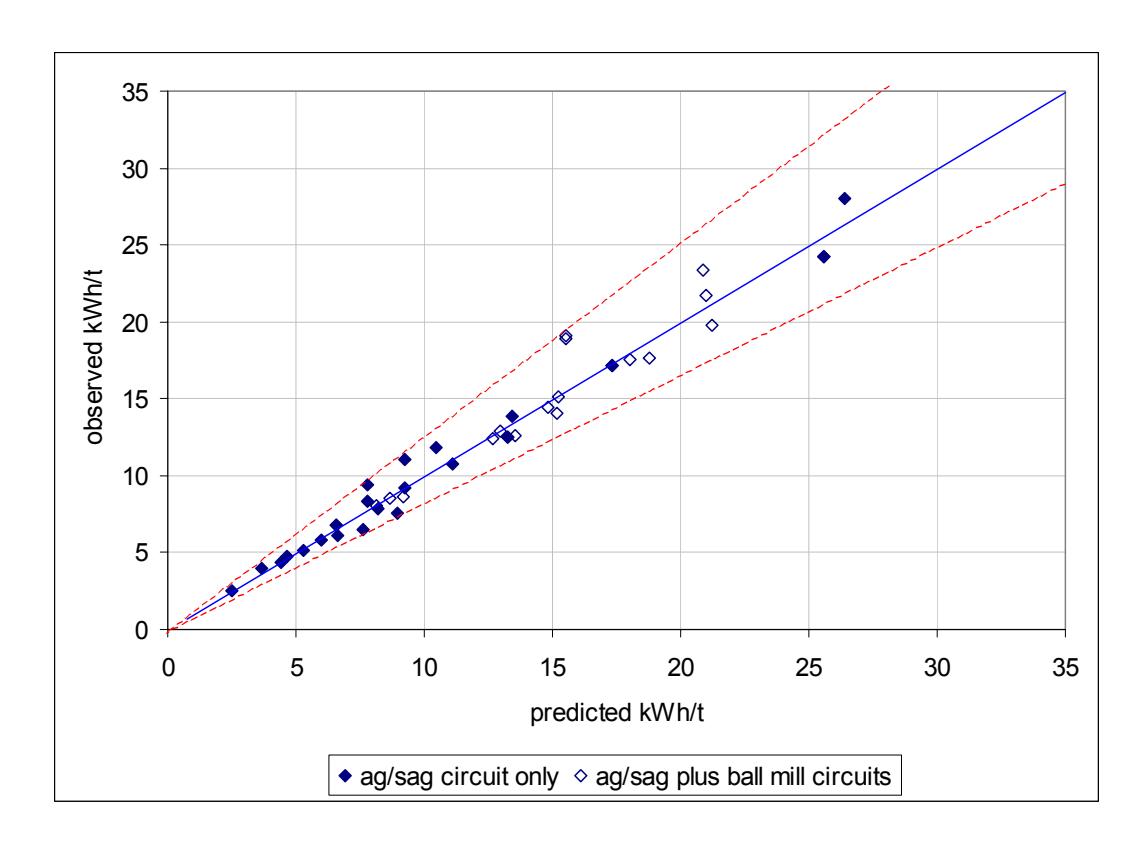
A companion equation was also developed for predicting transfer size. Combination of the two equations gives the AG/SAG specific energy as well as the transfer size, such that the SMCC operating work index remains fairly static regardless of AG/SAG operating conditions. To develop the approach 36 data sets from 24 different operations were used. AG/SAG specific energy and ball mill specific energy were predicted using DWi and Bond ball laboratory work indices. Ore types represented in the data base were from Al, Au, Cu, Ni and Pb/Zn operations. Ball charges were in the range 0-18%, F80 in the range 20- 170 mm, final product sizes in the range 56-350 microns and aspect ratios of the SAG mills 0.5-1.1. The results are shown in Figure 8, indicating a reasonable correlation between observed and predicted specific energies.
CONCLUSIONS
Many of the conclusions which have been reached in the past concerning energy efficiency and hence suitability of certain circuits for treating different ore types may have been incorrect. This is due to the fact that such conclusions were based on the application of Bond's equation to analyse the efficiency of different circuits. Bond's equation, outside of a fairly narrow range of feed and product sizes, is not applicable to tumbling mills in general and its use to evaluate the energy efficiency of AG/SAG mill circuits is not appropriate.
Using a more appropriate equation for analysing performance there are strong indications that there are little differences between the energy efficiencies of different circuits. However, HPGR machines appear to genuinely increase grinding efficiency.
With suitable measures of ore competence it is possible to predict the performance of a wide range of circuits without resorting to correction factors to account for apparent differences in energy efficiency. A so-called DWi has been developed for this purpose.
REFERENCES
Larsen, C., Cooper, M. and Trusiak, A.,2001.Design and Operation of Brunswick's AG/SAG Circuit, Proc International Autogenous and Semi Autogenous Grinding Technology,Vancouver, vol IV pp 350-367.
Morrell, S., Johnson, G. and Revy, T., 1991. A comparison through observation and simulation of the power utilisation and performance of two dissimilar comminution plants. Fourth Mill Operators' Conference, Aus.IMM Burnie, pp157-160. March
Morrell, S., 2003. An Alternative Energy-Size Relationship To That Proposed By Bond For The Design and Optimisation Of Grinding Circuits . International Journal of Mineral Processing , In Press
Morrell, S., 2003. Predicting the Specific Energy of Autogenous and Semi-autogenous Mills from Small Diameter Drill Core Samples. Minerals Engineering , In Press
Parker, B., Rowe, P., Lane, G. and Morrell, S. 2001. The Decision to Opt for High Pressure Grinding Rolls for the Boddington Expansion, Proc International Autogenous and Semi Autogenous Grinding Technology, Vancouver, vol III pp 93-106.